Passportplanepeachy

Passportplanepeachy
Where will we go next?!

Pages

Showing posts with label museum. Show all posts

Sunday, October 13, 2024

A Tartu Family Reunion: 10 Years Later

It's hard to believe it's been 10 whole years since I packed my bag and moved halfway around the world.  Trips since have made me wonder how I did it, since language barrier is something I have constant anxiety about while traveling. I tell myself I've done it before, and I still wonder how! (It's also been a long time since I've written one of these...) 

As I landed in Tallinn, I wondered if I had thought I'd return to Estonia. When people have asked about my year abroad, I've always known that what made my experience were the friends I made and the times we had. A few of them stayed longer than I did, one has moved in and out, but largely my friend group dispersed back to their home countries. Without them, Tartu isn't the same. So did I think I'd come back? I wasn't avoiding it, but it's a long way to go! 

Our group chat has been talking about a reunion for a while now, and while it sort of had a timeline, it also came together fairly last minute (at least for this long-range planner). But five of us managed to traverse Europe, Tallinn, and arrive in the 2024 European Capital of Culture! I did try the rhubarb and mint Capital of Culture-branded soda... not bad. 


With work schedules, we only had a long weekend, but we tried to make the most of it. We visited the restaurants that still exist and all the new construction: a new shopping center in the middle of town, a new museum (I'd visited the site previously had it just smelled of horse), plenty of remodeled and new housing,  pop-up bars in parks and along the river, roadworks... My internal compass wasn't as strong in Tallinn, but Tartu's came back, no problem. It didn't feel like coming home, but was certainly somewhere I knew well - like visiting Anchorage or London. Though having not used Estonian in 9ish years, I stuck to the basics, linguistically. (It's odd to recognize words but not remember what they mean.) The hotel I chose was one of the first parts of Tartu I saw in 2014, when the taxi driver (whom we practically had to beg to take us foreign students into town) tried to kick us out there, instead of at the dorm. A dorm I found out the next day is a very short walk away. 

Our first night back consisted of pizza, a night time stroll, and a couple drinks. I'd been gone away the longest, the others either still live in Tartu, moved out a couple years ago, or had visited since our time as Tartu residents. (I have seen all but one of my friends since leaving Tartu on other trips, like at their weddings, except one who I finally caught up with back in Tartu!) We talked about how our lives had changed, our outlooks, and even our conversations over the course of the weekend. Being "adults" sometimes doesn't feel any different from our student days, but other times it really does. 

We met up the next morning at the new National Museum - Eesti Rahva Muuseum - (see the previous horse-y field, that was, apparently, and abandoned air strip). The building is designed to still look like planes could take off atop it. It's MASSIVE and they have put some very cool tech inside. Once past the ginormous atrium, the exhibits will translate for you with just a tap of your ticket. And they'll copy the caption of the text to your own personal ticket-based-webpage so you can take the museum with you. Very cool. They've also done some really interesting museum construction pieces, incorporating HVAC systems into a forest display, having interactive Estonian language exhibits, creating cordoned off spaces in interesting ways. 

It wouldn't be Estonian without the weird elements, and I'm not even talking about the surrealist art display, since that's Czech. There was a exhibition at the back about some sort of cult-seeming rave group? Another downstairs that ended in the men's bathroom where you could take a quiz, receive a QR code from a juke box, and sing karaoke? Or just lay on an ottoman and pretend to be a moth. 

Across the street was the Upside Down House, Tagurpidi Maja, which only opened a few years ago. We agreed it was a unique experience, but not very time consuming and a bit expensive. What you get is right on the label, a house that is upside down. If you've played the game where you wander your own house holding a mirror and stepping over ceiling fans and door frames... it's just like that. It was odd and amusing, but mostly empty rooms. 


We ended the day with a birthday party in Russian/Estonian style. One of our number still lives in Tartu and we went to her place, met her husband and son, her friends and their kids, and listened to the medley of languages they speak to their children. Russian, German, Estonian, English... 1.5 of those I can manage. Apples were falling from the trees, there was plenty of food to go around, and we planned/debated a mad-cap adventure for the next day. 

Setting aside the debate and the drama, our next day was a road trip. We rented a car and headed toward the villages along Lake Peipsi. Our first stop was the Juhan Liiv Museum, the home of a 19th-century Estonian poet. A very enthusiastic caretaker gave an Estonian-only tour to Tobias, who translated at the conclusion of each building (while there are several, they aren't massively filled). We saw where he lived during his years with dementia and where his family lived while they farmed. We played on the Baltic swing, naturally; collected apples and read Liiv's poetry while eating them; saw the sandcastle built in honor of Liiv thinking he was destined to be the King of Poland. 

Our quiet day in the countryside continued at Alatskivi Castle. We wandered the grounds, took in the pond and lily pads, and even saw a snake! I don't think I've seen a wild snake before this little, black cutie slithered into the grass. While we'd planned to eat lunch at the Castle, their restaurant wasn't going to be open for longer than we could stay hungry, so we walked through the trees to a fish & chips shop before hitting the Onion Road. 


Apparently, the area along Lake Peipsi is known for producing high quality onions. Driving through Kolkja looked like a garage sale, but people only had stacks on stacks of onions (and some garlic). If agricultural products could cross borders, I'd have brought some home to test - they're certainly smaller than what we get here, but that says nothing about their deliciousness. We tried an onion hand pie which was very good, stopped at a few other shops while a friend shopped, before arriving at the Peipsimaa Heritage Center for their chicory.  

Now, I don't know anything about chicory, but seems it was a big deal at some point. The chicory museum takes up a floor of the heritage center, and its included in their cafe in the back. (Any of these shops and homes in Kolkja, one could just wander in the backyard and find a cafe or a restaurant.) We snacked and drank and enjoyed the weather. All five of us were together during the party and at this chicory cafe, and we still enjoyed each other's company after all this time. 

We visited Lõunakeskus the next morning, the shopping center on the edge of the city, which has had a major face lift in 10 years, but still has the ropes course over the ice rink, which I hope never changes. We tried to stop by the University Library, but since the semester hadn't started, none of the University buildings were open. But four of us met up for tea and cake at Werner, a classic of the Tartu student experience. Ordering my usual at Werner was 90% of the Estonian I managed while living there - a mango chai and their signature carrot cake (I got the last piece of the day!). One of my friends is now a researcher at UT and let us into the Linguistics building, so we did get to see inside ONE of our old buildings. This was the last of the time we'd get to spend together, unfortunately, with family responsibilities elsewhere. Here's hoping it isn't another 10 years before the next Tartu Family Reunion, but if nothing else, Tartu will still be there then. 

The winning design (or maybe just my preferred design?) for a new culture center in the middle of town. Currently, there's a nice park here. They didn't ask me, but I don't like the whole concept. 

I spent the extra time making sure to stop at the places I'd go all the time: my dorm, grocery stores, my walk to classes, the park bench where I stole WiFi from the trees for my first couple weeks abroad. And eating kohuke at every opportunity, constantly, for six days. Coming from somewhere with a high cost of living, Estonia will always be cheap to me, but inflation certainly has made its way to Eastern Europe - the things I used to buy regularly have doubled in price (kohuke up to 50¢ a pop), or gotten much much smaller (my poor stritsel). New books are half of what I'd pay for them at home, or cheaper, though they still can't compete with my local used bookstore. 

In the morning (Estonian Independence Day), before the train back to Tallinn, I walked up Toomemägi, just to make sure I still could. The "steep hill" isn't actually steep, but it always feels rough. Understandably, the walk is different without a full backpack and snow boots. Instead, it was a lovely sunny day where I could wander the church ruins at the top and think about the Middle Ages in which this town, and my university, were founded. I thought about buildings and tree roots and people, what life was like and how it's evolved. It was a pensive moment. 


Independence Day may have brought out a few more flags, and a message from the President on the trains, but wasn't filled with the pomp and circumstance - and parades - we expect of an American Independence Day. The train moved through the fields and towns and sunshine, and off we went afterward into the wild blue yonder. 

I haven't reread my blog posts of my Estonian impressions in years, and life has made my memory much worse than it was when I was in my "carefree" youth. There are pieces I remember, like: watching the Tallinn skyline fade from view as I took the ferry away for the last time in 2015; walks in the snow and deep talks with my friends; potlucks and potlucks and day trips; early morning and late night bus rides; fighting with a bus driver in Estonian; the fudging magpie loudspeakers; telling myself to say "yes" to new things; the literature class in English that was actually an architecture class in Estonian... This trip reminded me that while I don't remember being lonely in Tartu, I did spend a lot of time by myself. I walked to and from class alone, I spent many evenings reading or watching movies or doing homework, I took trips by myself, I didn't have friends in my classes (apart from Estonian). It also reminded me that each of my friends had a different Tartu experience than mine, and some have had more Tartu experiences since. 

Estonia has clearly had a lot of growth in 10 years, with its obvious construction, expansion, and development. I continue to love having studied some place "small" by many standards; it isn't a massive town to many - its population is big to me, but it's never felt big. I love having experienced Eastern Europe and being able to recommend it to my friends. I love the friends I made along the way and that we still get to peek into each other's lives from time to time. I love having challenged myself 10 years ago to take this massive leap and still don't understand how it worked out. 

Do I think I'll go back? 

Friday, December 14, 2018

Seeing the Sights: Dachau for the Holidays

As strange as it sounds, I did break up visits to Christmas Markets around southern Germany with a sobering visit to Dachau, the first Nazi concentration camp. I've been to Munich a few times, and hadn't comprehended how close the Dachau camp is to central Munich. Very easily reachable on the S-Bahn, free, and an odd piece of open space in a packed city. Obviously, the space was set aside for historical education purposes, and was the first camp to be set up as a museum (opened in 1965 and with much consultation from survivors). And in a new segment I'm adding to the blog, it's a 10/10 on the introvert's travel scale. I spent the day there and talked to no one. You don't need an entry ticket, signage provides all the info, and while not everything's in English, most is.

Since it was December, there was intermittent snow, and with each flurry, I thought about the person/movie/poem/wherever that talked about how, when crematoria first went into use in these type of camps, the residents thought it was snowing as the ash fluttered out of chimneys, and were horrified when the realization hit them.

----

A short walk from the bus stop, past the visitor center I briefly walked through on my way out, is the guard house with the "Arbeit Macht Frei" gate. This one is a recreation, since the original was stolen, later found in... Norway?, and is now under glass in the museum section. In addition to this note about the value of work, paint on the roof of the main building read: "There is a path to freedom. It's milestones are: Obedience, Honesty, Cleanliness, Sobriety, Hard Work, Discipline, Sacrifice, Truthfulness, Love of thy Fatherland."

Buildings left on the property describe various parts of life in the camp, and the property itself is mostly empty, with outlines of where barracks would have been. There's a nunnery at the back, crematoria off to one side, a Jewish memorial, block of solitary cells, and a maintenance building used as a museum and theatre (for a documentary about the camp) now.

This stands near the roll call grounds of the camp, and reads (in four languages): "May the example of those who were exterminated here between 1933-1945 because they resisted Nazism help to unite the living for the defence of peace and freedom and in respect for their fellow men." 
I started with the "Bunker," which was used for solitary confinement. Georg Elser was one of those kept here, who attempted to assassinate Hitler. Interestingly, cells were renovated for him, giving him three cells to move between, and he was allowed some personal effects. The "why" was never discussed, and I haven't been able to find it anywhere. Seems he should have received very different care...

Other individuals kept in the Bunker were clergymen, who had a set of cells to themselves (one person per cell), one for religious services, and another for day use. Three other cells were subdivided, leaving no space in each for a prisoner to sit or lie down: the "standing cells."

After liberation, the Bunker was used as offices for US military personnel, and was given a new coat of paint, which is still visible. A nice teal. Cell by cell, one can see peeling paint, broken pipes, etc., which probably aren't a whole lot different from what it would have looked like in it's heyday.

Shower room: then and now
This room had many purposes: bathing house, cinema, site of corporal punishment, concert hall
The museum started with an overview of the war's progression, specifically with the opening of concentration and extermination camps, subcamps, youth protective custody camps, ghettos, etc. throughout Europe. This system stretched the length and breadth of the continent. Dachau itself was opened in March 1933 to house political prisoners. By accounts, it doesn't operate in the modern conception of a concentration camp for some time; people are under watch, under fed, and barracks overpopulated, but they don't have the same level of suffering as modernity ascribes to concentration camps of the era. This would change, ramping up toward the end of the war. Medical experiments begin in 1942 along with corporal punishment, typhus breaks out in 1944 (63,000 people live in barracks built for 8,000).

At the end of the museum, some Dutch high schoolers had been part of a project to follow the lives of Dutch political prisoners in Dachau, called "Names, not Numbers." This exhibition was done in German and Dutch, so I couldn't follow much of it, but students read through their biographies, and many had artifacts from "their" prisoners and interviewed family. Another room had headstones of those whose last known location was Dachau.

After liberation, tens of thousands of people remained at Dachau, with no where else to go or awaiting assistance to return home. Refugees lived here for years after the war, with only the crematoria set aside as a place of remembrance. I did visit the crematoria area, which was expanded as the war went on, and it also included several gas chambers. I had some thoughts on how I might have portrayed things differently to make more of an impact on those visitors, but this is also a subject in which capturing realism isn't always possible... or a good idea.

----

As this post is being written 10ish months after I visited, all the thoughts aren't as fresh. I've probably missed things, but that's the way life is. In summary: I visited a Concentration Camp for Christmas. 

Saturday, November 5, 2016

The 8th Weekend

Early early in the morning, a group from my office went to tour the White House! There were a few complications, but we finally got through the security line (coolest security procedure ever) and headed into the People's House. Because it's almost Halloween, there were displays of the ghosts seen around the building: Lincoln Haunting the Lincoln Room, Abigail Adams doing laundry in the East Room, etc.

Even the White House decorates for Halloween.
(In the East Room)
The portrait of George Washington is the only thing that has continuously been in the
White House since the turn of the 19th century. 

Chillin' in the same rooms (and entry ways) used by all the important people.

The rest of the day I spent at the Daughters of the American Revolution Museum, which was much more epic than I thought it would be. Of course, they have a hall that should really be holding an 18th century assembly dance. The entire building is full of tiny rooms, each sponsored by a state's DAR chapter, that cover some decade or theme; a music room, a children's room, the kitchen, a 1760s dinner party, or maybe a 1820s parlour is more your speed. 

And as expected the DAR Library is amazing, and houses a huge (massive, ginormous) genealogy collection. 

Each of the little "Period Rooms" were very cool, but after my trip to Salem, the kids room stuck out most, with its Witch Staff over the door, to keep witches out and little chitlins safe during the period of the Trials.
All in all, not a bad trip, especially since admission is free. I went specifically because they're highlighting the fashion changes throughout the time periods covered. Each Period Room held special notations on fabrics, styles from overseas, the change in silhouette, etc. Clearly, I have lots of sewing to do when I get home.


(Authors Note: I feel like this post needs more, but at the moment I just want it out of my drafts folder. :) )

Monday, September 26, 2016

Work Week Kolm

Some of the things I did this week include: 

Visiting the National Museum of African-American History & Culture

The exterior of the building is actually glass with a filigree on the outside, so you can see through the building once you're inside. The inspiration for the architecture comes from an African queen's crown. The museum covers six floors, six packed floors. There is so much to see and read. We were only given two-ish hours to explore, and there was no way we could do the entirety in that time. 

This exhibit on sit-ins was designed to make you part of the movement. Bar stools up against a counter-top and backdrop of screens illustrate the struggle of students and others to gain equal rights.
This statue represents the Olympic win in Mexico City in 1968. Tommie Smith & John Carlos of the U.S.A. won the Gold and Bronze medals in the 200 metre running event. They stood shoeless in black socks to represent poverty in the African-American community. More about the history and symbolism of the event here.
This display was the largest on the topic of African-American participation in social organizations, specifically membership in the Masonic Family. It included a bit on the founding of the Prince Hall Masons as well as the African-American chapters of the Order of Eastern Star. 

There is really no adequate way to discuss all that this museum covered. Hundreds of years of history, exhibits on art, music, cinema, sports, movements for suffrage, citizenship, rights, and recognition. There is just so much. 

George Washington's Mount Vernon

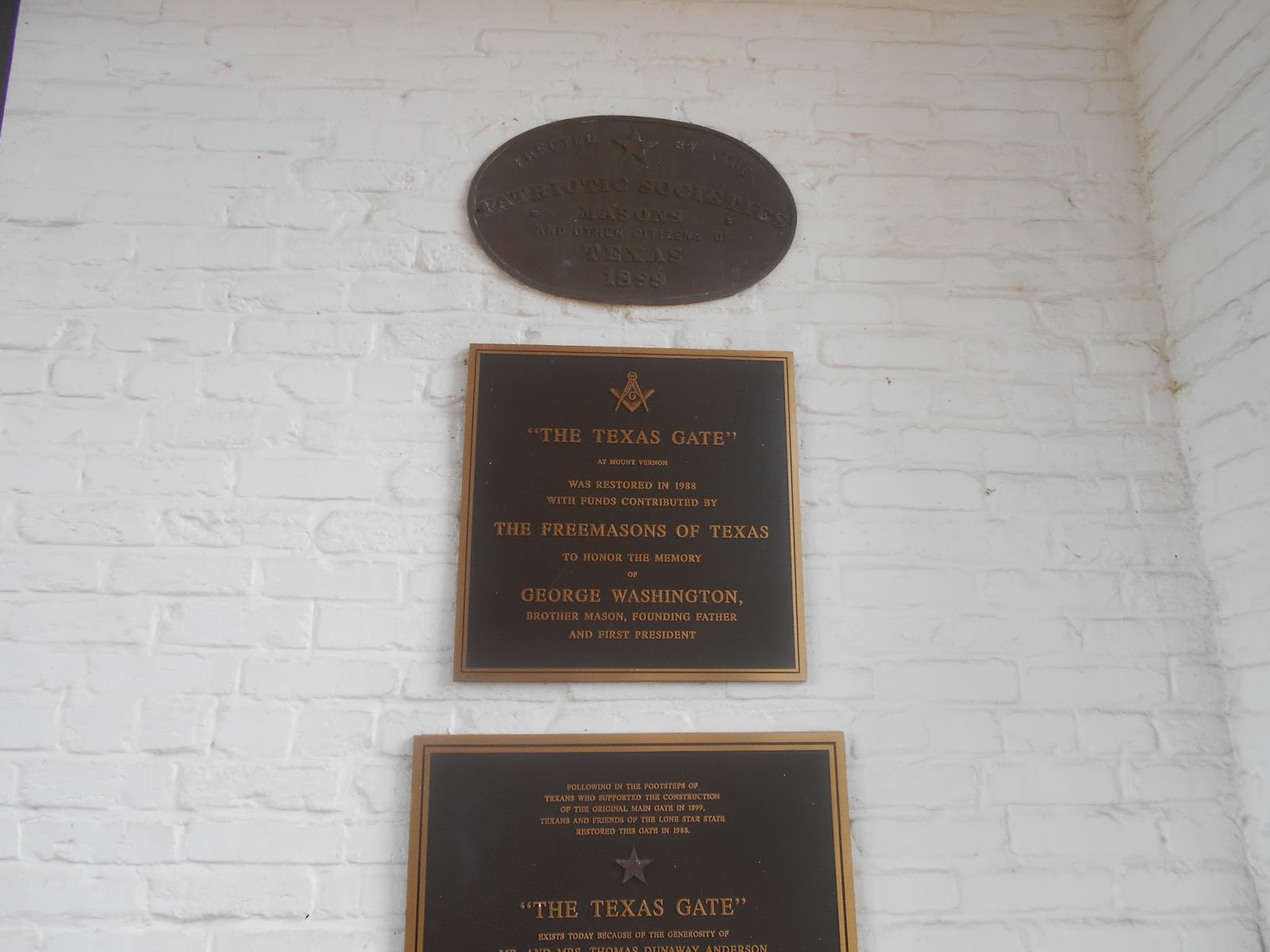
Grand Lodge of Texas, fixin' up Mt. Vernon's entranceway.
Look out at what would have been the slave village on the Mt. Vernon property. At the left corner near the "beach" was a couple of people who spend their day cooking period foods in a period-appropriate fashion. And then they eat it. Kinda jealous.
This section of Mt. Vernon also held an interesting example of the various forms of fencing used. While it makes sense when I see it, I wouldn't have thought there were different ways to lace wood and twigs together for a number of purposes.
And here are Washington's teeth, made of several things, none of them wood.  Everything I thought I knew about the world is wrong.

Turns out, Washington started loosing his teeth in his teens, thought he had some of the best dental hygiene. It was one of the reasons he smiled so rarely, because his teeth caused him so much pain it was just easier.


When did we decide this was not the most awesome way to travel? This was one of the displays that made me think about historical locations like this. George Washington died, but his farm went on. Martha Washington died, and the farm goes on. But one day, the carriage is pulled into the carriage house, saddles are hung on the wall, and there they stay to this day, gathering dust. How does a working farm go from productive and money-making, to a display through which tourists wander?


Keeping up with the Bronze Washingtons


Other thoughts from Mt. Vernon:
1) The museum exhibit starts with pre-military Washington, and then moves into Washington as a young British officer. I think this is an interesting point to make. He was good as an American general because he knew how the British think, after being a loyal British colonel. 
2) There's a super cheesy video about the romance between Mr. & Mrs. Washington. There's a lot of cheese in the videos at Mt. Vernon, but there was a 4D theatre with some period drawn maps rendered in "3D" to illustrate troop, artillery, and naval maneuvers. I thought that was a cool feature. 
3) There was a display, the specifics of which are beyond my recollection at the moment, which discussed G.W.'s humble nature, quiet demeanor, and other quietness of character. While I'm not saying all these characteristics are mutual exclusive, it caused me to wonder if all of the pomp & circumstance, all of the drive/ambition/goals for the future, all of the things we historically admire in Washington: were all these things the real Washington, or over the course of time have we attributed more to him because, as our first president, we needed him to be a hero? Because if he was all we say he is, he would dislike so much about what Mt. Vernon has become.


HQs of the NWP

As possibly illustrated in my post about the Sewall-Belmont House, I'm interested in suffrage movements. I had afternoon plans, but was looking for something to do with my morning. I found a note in a museum about the previous headquarters of the National Women's Party, so I looked it up to try to find the old address. And instead I found the list and location of the five headquarters of the NWP in D.C. from 1913 to 1929. So I went on a hunt. I've found four of the five, so stay tuned to see the final one. 

The first HQ was in a basement office at 1420 F Street NW.
Today, there's this giant hotel at the address.

In 1916, the NWP moved to Cameron House, 21 Madison Place NW.
Everything on this street today has historic significance, though
the HQ of the NWP isn't marked on any of them. One of these buildings
is on the spot (or the same building) the NWP used, though the back building is
most famous has being the home of the Madisons. 

From 1917 to 1922, HQ was at 14 Jackson Place, in a building on the location
of one of these. Like many streets, Jackson Place has been renumbered...
The location of #4 is still being sought; research still to be done.

And #5, the HQ of the NWP from 1929 on, they resided at the Sewall-Belmont House. 

Monday, September 12, 2016

Work Week 1

This post is a bit delayed as I tried to walk that delicate line between recording the experiences of my internship for my own recollection later and the fact that the internet knows everything about everyone and is full of people who could very well find out where I work and creep hard.

So, here's a vague idea of what I did this week!

Item 1: I went on a tour of the Capitol Building, and it was super cool, so I'll definitely be back!

Ceiling near the Old Senate Chamber 
Item 2: I got French Macarons. I've been wanting to make these for months, but they require special ingredients not readily on hand and, from what I understand, are super time consuming to make. Feeling like I should be doing something afterwork other than going home and watching "Madam Secretary" or YouTube videos, I headed into the great wide somewhere and acquired these beauties.
Flavors & Rating:
Vanilla Violet *
Pineapple Sage ***
Hazelnut ***
Raspberry *****
Blueberry something Thyme ****
Lavender ** 

There were a few on the online menu that weren't in store the day I visited, so I'll have to go back, but I picked up a few flavors I wasn't sure I'd like. I've recently found I have to be in the right mood to like lavender, so wasn't surprised when I didn't like that much. I'm not sure when I've had violet before, but that was not the time. 
On my walk home, I passed the Capitol, all lit up, calm, sans tourists. It looked pretty cool, so I felt obliged to stop and take a few photos. It was also craaaaazy hot outside. 

Item 3: Tidal Basin Paddle Boats
Checked this off the D.C. Bucket list! It was super hot outside and I ended up just allowing the current to move the boat, so I would only have to put in the effort to get back.


Item 4: Post Tidal Basin, I visited the closest museum (as I was desperately in need of A/C). It just so happens the closest museum was the U.S. Memorial Holocaust Museum. I was expecting something a bit different from the reviews online than what I ended up seeing when I walked through the museum, but there were several things they did that I have to give them kudos for.
1) They had a large display on how the Holocaust affected Eastern Europe. I'll admit, I'm partial to Eastern Europe, but much of the history taught on this subject in the U.S. focuses on Western Europe and Poland, and I was glad to see the emphasis on how widely people were affected by the Holocaust. There is even a room several stories tall filled with pictures of people who lived in an almost entirely Jewish town in Lithuania which was wiped out over a short period of time.
Video of Holocaust survivors from Latvia & Lithuania
2) They had a floor dedicated to the genocides that have taken place since the end of WWII. For all our "Never Again" speeches, genocide is still a daily reality and has been since our first "never again." We say we'll never let it happen again, and while nothing has happened on the 6-million-victim scale, genocide has occurred again and again, in Cambodia and Africa.

3) They discussed the U.S. reaction at the time. History classes teach "The Nazis did this, the French did that, the USSR did this other thing." What did we do? Essentially, nothing. I didn't listen to the entirety of all 5 ways the U.S. reacted, but I sat through most of them. President Roosevelt removed the U.S. Ambassador to Berlin, and we thought, "That'll do it. They'll give up." knowing full well many many many people were being killed while we shook our heads.

4) One floor as the history of Jewish persecution. The Nazis weren't the first; not by a long shot. It took the Vatican nearly 1500 years to apologize for their initial persecution and subsequent centuries.

5) The translations into Hebrew. The poem below rests above a collection of shoes from a concentration camp in Poland:
We are the shoes. We are the last witnesses.
We are the shoes from grandchildren and grandfathers.
From Prague, Paris, and Amsterdam.
And because we are only made of fabric and leather
And not of blood and flesh,
Each one of us avoided the Hellfire.
-Moses Schulstein
And finally, 6) The exhibition pieces from lesser known concentration camps continue to show how many there were, not just Dachau or Auschwitz, but many many more from all across Europe. In addition, many of the pieces were casts, or replicas, which I think is important. Those artifacts should remain in situ to be teaching tools for those cities and regions. In terms of the piles of clothing, shoes, hair, etc. that are on display at Auschwitz, removal of portions of those piles kind of diminishes the effect. The United States had no concentration camps like these, and we stood back and watched for so long, why should we take important pieces of history from the countries to whom they belong and who suffered for them to exist? 

It's a museum visited by a lot of senior citizens, and that's just fine. But the standing in the middle of hallways, walking directly in front of someone to press up against an exhibit so no one else can read around them, the inability to whisper... all diminished the overall experience at the museum; I was ready to be far away from all the people.

Item 5: I visited the Flea Market at Eastern Market. I'll have to time my visit next time so I can snack or pick up some fruit for the road. Not much to tempt me, though one skirt made an impression but isn't in a style I'd be able to wear to work. :( 


And those are some of the big things I did this week. I'm still getting into gear at work, with full-time employees adjusting to having interns around there haven't been many projects to do, but as time goes on I'm sure things will pick up. 

Saturday, September 3, 2016

Seeing (Some More of) the Sights: D.C.

 After brunch, I began the day with the Will & Jane exhibit at the Folger Shakespeare Library. It covered the works, biography, cult of celebrity, and growth in popularity of William Shakespeare and Jane Austen. The exhibit discussed how Austen was influenced by Shakespeare: she included him in her own works, attended performances of his plays, even lived down the street from a gallery that only held paintings of scenes from his works for a time. While not a comparison of the two, each display held themed artifacts and pieces from each writer: items from under their floor boards, parodies of their novels, clothing items with their faces or writings printed thereon, film adaptations, versions handed out to soldiers, etc.
Not sure they quite thought through the cover...
It was a really interesting exhibit, especially to compare with things I already knew about Jane Austen and pieces I'd seen originals of at her house when I visited, like her turquoise ring. Jane only owned 3 pieces of jewelry, and when I visited it was the first time they'd all been together since her death. I was surprised they loaned it out, but turns out this one was a replica Kelly Clarkson had purchased. There was a screen with a selection of British actors and clips from the parts they'd played in a Shakespeare and Austen production (i.e. Laurence Olivier in Pride & Prejudice and Hamlet; Alan Rickman in Sense & Sensibility and reading Sonnet 130). And when I first walked in the building the woman at the front desk said, "Don't miss the shirt." So I found the shirt. On display, Colin Firth's lake scene shirt, and on the scene behind an endless loop of it and reproductions of the lake scene. 

I loved this quote at the end of a display on fan continuations of the stories these famous writers can no longer write themselves: "Fans are not merely passive worshippers of the celebrity of these authors but its creators, producing new art - high and low, bad and good - in continuing celebration of the art of William Shakespeare and Jane Austen." Imitation is the greatest form of flattery, they say. And I loved the tagline on someone's take on Macbeth from 1866(1806?): "Wherein Duncan is murdered, Banquo is murdered, and everything is murdered for the entertainment of the young at merry Christmas time. 

After lunch at Taco Bell (surprise), I went to the Sewall-Belmont House & Museum. I visited Alva Belmont's first house in Newport when I was there this summer, and this new house of hers is certainly different. The Sewall-Belmont House became the headquarters of the National Women's Party in 1929, and currently serves as a museum for all things women's suffrage. I've written several papers on the suffrage movement in the United States and studied the British movement (though I haven't seen the new movie), particularly the violence visited upon both groups of women. I was really excited to see artifacts and hear more about the women involved. Unfortunately, overall, I was disappointed; there were very few things said I didn't already know. On the plus side, it means I did learn something at university. It was still an awesome visit. 

With Susan B. Anthony's desk and Elizabeth Cady Stanton's chair, elongated to fit her bustle. 
Knowing the audience most likely to visit a museum on women's right to vote, they've made every mirror in the building a selfie spot, but with an individual message. I hate the "camera in the photo" selfies, so I didn't take many, but this one has the portraits of some of the most famous US suffragists, so I think I'll keep it. At the bottom of the mirror it says "This is what a leader looks like."
This one says "I stand on the shoulders of the women before me." 
One of the rooms held cartoons from the Suffragist and other suffrage cartoons. I liked this one most. It says "Question: How can this be a 'goverment of the people and by the people' if only 1/2 of the people vote?" In its suffrage context, the meaning is plain. However, as a kid with a PoliSci degree, this was interesting because even for presidential elections, less than 50% of Americans vote, period, making this still a relevant and topical question. 


I really like the idea of the jail door pendants that the suffragists wore after they'd been arrested, but I have done zero things cool enough to deserve it. 

Post-epic-suffrage-artifacts, I was heading to the hip-and-happenin' region of Georgetown. Unfortunately, I took the wrong turn down a street and ended up...
In front of the White House.  Legitimately, I did not plan to end up here. What is my life right now?! I got directions the other day that said "turn left at the Library of Congress." What is this?!?!

Sunset, predominately orange,
over all the things.
On my way home, I was treated to my first D.C. sunset, and it did not disappoint.
Better picture with the Capitol,
but further away.
AND!! I'm actually super excited to continue including posts of Embassy for Embassy Bingo. Today, I saw the Mexican Embassy in this modern building currently in the process of swallowing these two smaller buildings. Stay tuned for my trip to Embassy Row!


P.S. I also acquired a roommate today!